
As Easter approaches, I can’t help but notice the abundance of bunnies everywhere—it’s overwhelming! As a Christian grounded in the essentials of my faith, I envision a world where the bunny is replaced by the Lamb. After all, Easter, or a more proper term is “Pascha” (πάσχα) in Greek, which translates to “Passover”, is not about the bunny; it’s about remembering the Lamb of God, who loved us to the point of death and was raised to redeem our sins, offering us the chance to spend eternity with Him.
I celebrate only a few festivities, and I believe that Christian holy days should be honoured just like those of any other religion. Unfortunately, the enemy of our souls, Satan, has relentlessly worked to hijack Christian traditions by influencing those in power to dictate what is considered politically correct. For instance, Easter has been co-opted by the image of the bunny rather than the Lamb. Similarly, Christmas is often viewed as offensive to non-believers, leading to its rebranding as the “Winter Holidays” to be more politically correct.
Interestingly, holidays from other religions are not subjected to this same scrutiny. Ramadan is still called Ramadan, and no one wishes others a “Happy Spring” during this time. So why has “Merry Christmas” been replaced with generic phrases like “Happy Holidays” or “Season’s Greetings,” especially in the USA? While many in Britain still prefer “Merry Christmas,” the use of generic terms is becoming more prevalent each year, particularly in email signatures. Proponents argue that this is meant to foster inclusivity, but as a Christian, I feel excluded when I hear or read “Happy Holidays” instead of “Merry Christmas.”
Those in power seem to use the guise of inclusivity as an excuse to exclude Christians and Christ from our own celebrations. What sense does it make to include others while sidelining Christians? They claim this is for the sake of respect and inclusivity, which should be commendable, right? After all, Christians are taught to be respectful and inclusive. But what does it truly mean to be respectful and inclusive? Where do the boundaries lie, if they exist at all? If someone does not believe in Christ or celebrate Christmas, why should they be concerned about the traditional greeting “Merry Christmas”? This situation may stem from the fact that Christians have faced persecution since the beginning. “Happy Holidays” may seem more inclusive, but why would non-celebrants of Christmas be offended by it? Muslims say “Eid Mubarak,” and Jewish people say “Happy Hanukkah” or “Chag Chanukah Sameach,” and these greetings are widely accepted. Yet, saying “Merry Christmas” is considered impolite for not being “inclusive.” I wonder why Christian celebrations and sayings are deemed more offensive than those of other religions. It feels as though I am being deprived of my essential human right to freedom of religion. I do not wish to be narrow-minded; all are welcome to celebrate Christmas with us. However, we should not be accused of being disrespectful simply for preferring to say “Merry Christmas.” We are not imposing our beliefs or greetings on anyone; but “Merry Christmas” is a traditional Christian holiday and greeting. Yet, it seems others are imposing “Happy Holidays” on us, which feels disrespectful and exclusionary. So, should Christians be inclusive enough to exclude ourselves? Thankfully, although for thousands of years, they have tried to eliminate Christians countless times, countless times Christians have thrived. I can only take comfort in knowing that evil will not prevail against The Church because it wasn’t built by a group of people, but by God (Matthew 16:18).
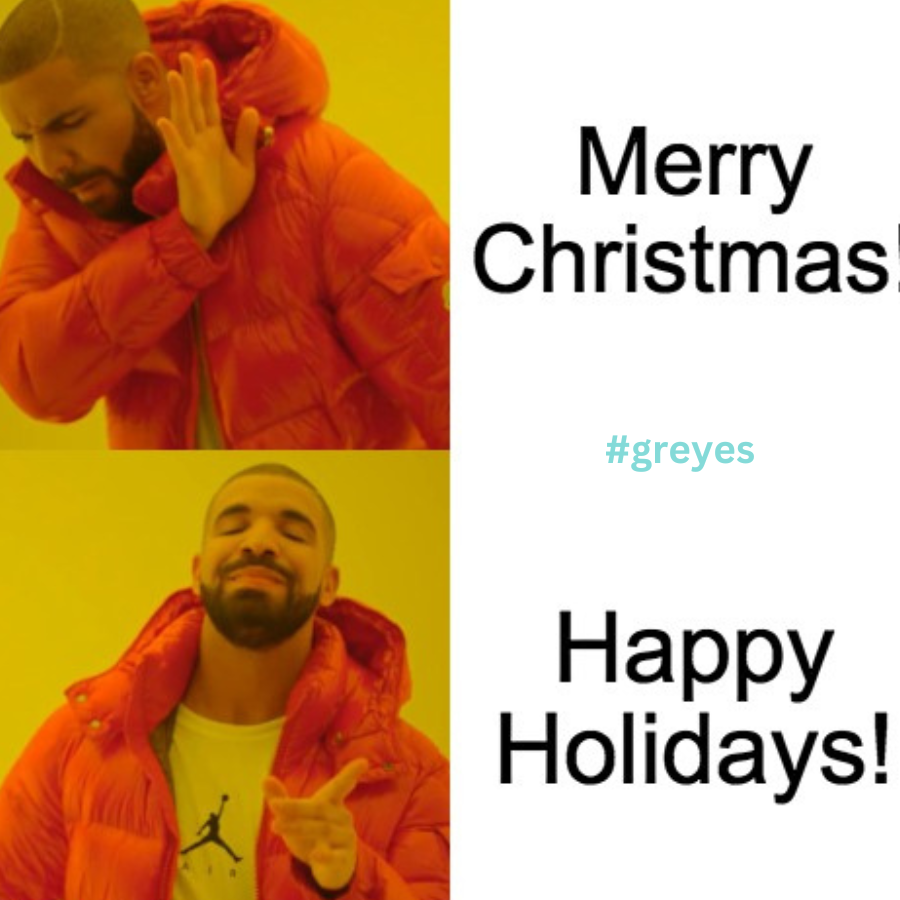
It’s a vast and diverse world, making it impossible to please everyone. Each culture should be free to celebrate their own traditions and sayings. If some prefer a generic celebration, that’s fine, but Christian festivities deserve the same respect and recognition as any other religious observance—without fear of being perceived as intolerant. Christians should have the right to express their beliefs openly and celebrate their faith, saying “Merry Christmas” without being labeled as intolerant towards others. After all, Christmas is about Christ; CHRISTMAS STARTS WITH CHRIST.
Can you imagine telling a Muslim not to say “Eid Mubarak” and instead replacing it with “Happy Holidays” or “Happy Spring”? Neither can I. So why do people seem convinced that Christians should simply accept this erasure of their own celebrations? Have you seen Muslims speaking about their beliefs? They’re very passionate and they aren’t ashamed to stand up for what they believe and so they get the respect and recognition they want, that’s why they have exemptions at work like day offs on Fridays, at least here in the UK. But Christians are treated like unbelievers, and are usually even expected to work on Sundays, which everyone knows it’s the LORD’s Day and it is the day that Christians attend church. We don’t have this recognition from our employers because we blend way too much, and that answers my question above, that’s why people expect Christians to just comply, that’s why people believe Christians will agree to everything. I get it, as Christians we don’t want conflicts so we just stay silent about our beliefs because we don’t want to offend or impose our beliefs on anyone, so we blend & ‘bend’ too much that we end up losing our traditions and the sacredness of our Faith.
1 Peter 3:15 talks about being ready to defend the Faith. This is what we call ‘apologia’ (ἀπολογία) in Greek, which means Apologetics, a branch of Theology that specialises in defending Christianity. Those who practise Apologetics are called Apologists. But the truth is that you don’t need a Theology degree or specialise in Apologetics to be an Apologist. God wants us all to be Apologists: “but in your hearts honour Christ the Lord as holy, always being prepared to make a defence to anyone who asks you for a reason for the hope that is in you; yet do it with gentleness and respect,” (1 Peter 3:15, ESV Bible). Therefore, The Church needs more Christian leaders who aren’t people-pleasing but God-fearing, those who are biblically correct instead of politically correct, and who will stand up for the Faith and not just blend in the society. The LORD paid our salvation with His death and it should be honoured, as the above verse says. Every time a Christian defends the Faith, they’re honouring God, as long as it is done with respect. Thus, Christians shouldn’t be conformed to the ways of this world, which we can also find in the following Bible verse:
“And do not be conformed to this world, but be transformed by the renewing of your mind, that you may prove what is that good and acceptable and perfect will of God.” ~Romans 12:2 (NKJV)
God calls Christians to be assertive in our faith and to be prepared to defend it when necessary, rather than remaining silent about matters concerning our beliefs. By “defending,” we do not mean resorting to violence, but rather engaging in reasonable arguments that articulate our beliefs. THE CHURCH IS IN DESPERATE NEED OF REVIVAL; it must return to its foundational principles. Christian leaders should stand firmly for the Church in the face of authority and societal pressures. The challenge is that many church leaders fear offending others, yet they fail to see that their silence contributes to the secularisation of Christianity. The enemy of our souls, Satan, is aware of this vulnerability. He understands that Christians—especially church elders or leaders—often dread being perceived as intolerant, leading them to lose sight of what truly matters: our Faith.
I believe that being tolerant doesn’t mean being silent, especially when it comes to our Faith. We can defend our rights and beliefs while remaining respectful of others, and it is reasonable to assume that inclusivity can coexist with the preservation of our traditions. Christian leaders may argue that Jesus commanded us to love others, which is true; however, both Jesus and the apostles were never silent about their faith. They were not afraid to offend others, nor were they people pleasers (Galatians 1:10). In fact, not only did the disciples speak boldly, but Jesus Himself also offended many by preaching the truth. This boldness led to persecution, with many disciples and even our Lord Jesus facing death because their message challenged the status quo and offended those in power, particularly the Pharisees (Matthew 15:12-14).
Let’s reclaim our Holy celebrations. Don’t let Christmas be secularised by just agreeing to name it ‘Holidays’. God paid an immense price by sending His only begotten Son into the world and Christmas is remembrance of that, not some winter holidays. It’s time to reclaim Christianity and its traditions and return to basics without fear of offending others. We have been silent for far too long, and it’s disheartening to see how the early Christians, including our Lord Jesus Christ, were so passionate about sharing their faith and standing firm in their beliefs, while we just let the world dictate how to observe our Faith.
Christian leaders and those who are in power, Christians are facing modern-day persecution, and God’s people need you to wield your influence to restore the honour and the freedom that the Church, the Body of Christ, rightfully deserves.
JGR, the person behind Greyes, is a passionate follower of Jesus, and she delights in studying God’s Word, as well as encouraging others to deepen their relationship with Christ. She has attained a Certificate of Higher Education in Theology, Ministry, and Mission from Durham University and holds a Bachelor of Theology from the University of Oxford. Her theological education is distinguished by a robust academic emphasis on ancient Biblical languages (Hebrew and Greek) and Apologetics. Additionally, with her academic background in Art & Design and a Master of Science in Podiatry, she is dedicated to pursuing both fields when not composing works on Theology. In her leisure time, she enjoys reading, hiking, and cooking.

 GREYES