
Have you ever been so offended that you said to yourself you feel you don’t have the strength to keep overlooking people’s offences? In this biblical passage, Jesus is helping his apostles to understand how powerful faith is even if we only had faith the size of a minuscule mustard seed, we could make a sycamine tree uproot itself and be planted in the sea. This is significant because:
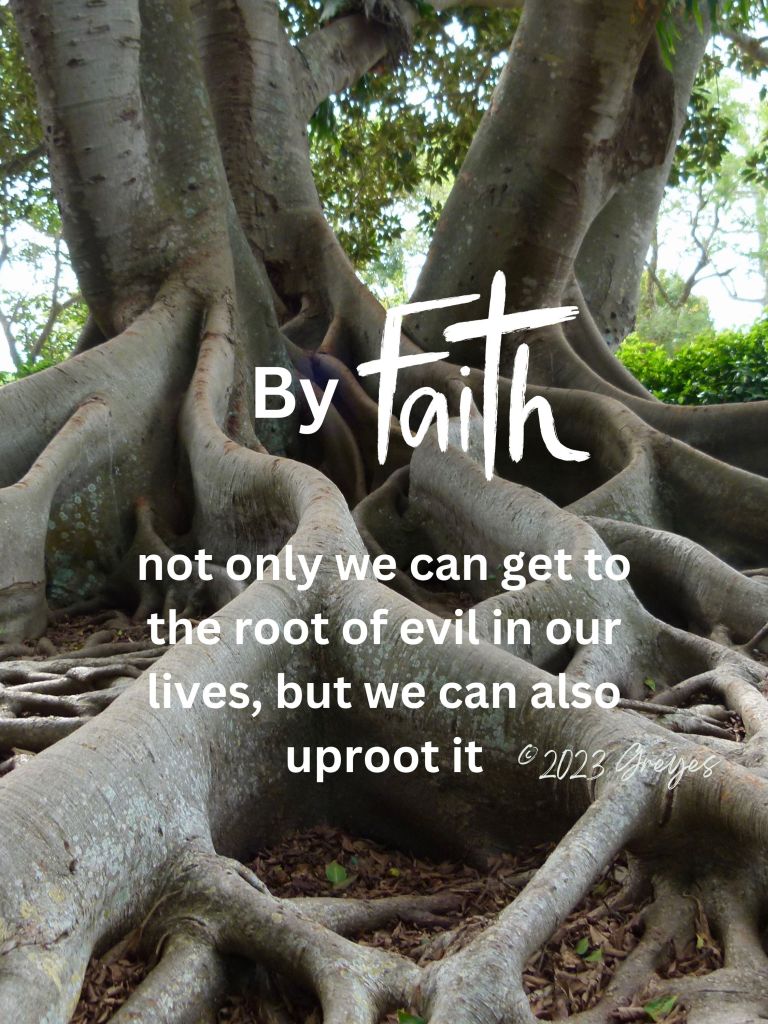
1. The size ratio here is mind-blowing. Can you imagine a tiny mustard seed uprooting a massive sycamine tree with its many thickened deep roots? (Just in case, I’ve included an image to illustrate that, please see below). Of course, it’s not the mustard seed uprooting the sycamine tree; figuratively speaking, it’s a faith of that size. To give you a rough idea, a mustard seed measures around 1-2mm while a sycamine tree can reach 100 feet tall and 3-8 feet in diameter. Some argued that mustard seeds aren’t the smallest of the plant kingdom and that Jesus wasn’t accurate in His teachings, but even if we were talking about larger seeds, it wouldn’t make much of a difference. On top of that, I’m pretty sure Jesus didn’t have a botanical lesson in mind here. As we all know, Jesus liked using hyperboles and relatable subjects (His audience was more familiar with mustard seeds than orchids’) to emphasise His point.

2. A sycamine tree has an invasive, thick, deep root structure so only loosening the soil would require specialist machinery; digging a hole with a shovel wouldn’t be enough. Let alone uprooting it. This is how difficult it is to eradicate unforgiveness from the soil of our hearts, as it can invade all aspects of our lives profoundly.
3. A sycamine tree is resilient because its roots crawl into the deepest underground so it’ll be impossible to kill it as there’ll always be some remaining roots, so more often than not, it’ll find its way to spring back. For the same reason, its roots can tap into the deepest water source under the earth, and thus; its survival is guaranteed even in times of severe drought. A sycamine tree grows slowly, but once it is deeply rooted, the tree grows quickly and develops extremely thickened roots as years pass by. The roots will even cling to one another to ensure their dominance of the soil. In the same way, once the root of unforgiveness takes place in the soil of our hearts, it can grow speedily, and if we fail to address it promptly, these feelings of bitterness and resentment are magnified as time pass by, and it’s harder to get rid of because just as the sycamine tree is supplied with nutrients from the soil, our unforgiveness will keep feeding from the bitterness deep within, caused by the offences of others. Have you ever forgiven someone and found out that deep inside, you still didn’t fully forgive that person? Because somewhere, somehow, there’s still a hint of bitterness and resentment towards that person. This is why unforgiveness is compared to a sycamine tree.
In a few words, in this passage, Jesus uses the sycamine tree to illustrate unforgiveness that can become deeply rooted in the soil of our hearts. Jesus understands how unnatural and extremely hard it is for us to forgive others that He compares it to uprooting a sycamine tree with a single command. However, as complicated as this may seem in the natural, through faith in God it becomes simpler for with God all things are possible (Matthew 19:26). Therefore, by faith, we could command unforgiveness in our lives to be plucked out and it would obey us, which implies that we could become masters over evil for its obedience to us implies its subordination.
Why do we need to forgive?
This may not be an exhaustive list, and I encourage you to spend some time with the LORD to see if He reveals more reasons why you should start letting go of unforgiveness. For now, here are some Bible-based reasons:
- First and foremost, we need to forgive others because God forgave us (Ephesians 4:32; Colossians 3:13)
- We need to forgive to be forgiven (the LORD’s Prayer in Matthew 6:12; Matthew 6:14-15; Matthew 18:35; Luke 6:37)
- Unforgiveness leads to bitterness (Ephesians 4:31), which is poisonous (Acts 8:23), and is considered unrighteousness (1 John 1:9)
- Being unforgiving results in defilement. Not only you’ll become defiled but many could become defiled too (Hebrews 12:15). Ultimately, it leads to death (Job 21:26; Romans 1:29-32)
- Not that we should forgive, but we must forgive. This is because it is our duty to forgive (Luke 17:10)
The truth is forgiving people who offended us once can be a real challenge, yes even for a Christian. Let alone forgiving the same person seven times and… in one day! (Luke 17:4)… No wonder after Jesus said this, the Apostles immediately asked for more faith. For a Christian, forgiving isn’t optional. Read how Jesus conveys that message in the next verses (Luke 17:7-10). In God’s eyes, forgiving others isn’t something extraordinary that we do and expect a reward, but it’s the least that we can do; moreover, it’s our duty.
So, how do we get this type of faith powerful enough to move mountains (Matthew 17:20) and uproot the evil roots of unforgiveness in our hearts? This passage starts with “LORD, increase our faith!” (Luke 17:5), so it’s a good start to ask the LORD for more faith. However, ‘faith by itself, if it does not have works, is dead’ (James 2:17). Therefore, faith will require action, that is, obedience on our part. This is evident when the servant “did/done what was commanded” (Luke 17:9-10), which in this case refers to God’s commandment of forgiving others. Thus, faith includes obedience to God and it leads to forgiveness.
Forgive the parent who never took care of you, thank God for using them to bring you to this world, but let them go because you have a heavenly Father and you can rely on His unending Love. Forgive the person who took your love for granted, abused you, or cheated on you; again, let them go because for as long as God exists you’ll be Loved, and that’s forever! The other loves are just a bonus, a gift from God. Forgive the friend who walked away or betrayed you, remember that Jesus knows how it feels to be betrayed by his friends. In the same way, forgive the teacher who failed you, remember how the Pharisees “failed” Jesus for His teachings were radical. Forgive the people who talked behind your back, the people who abused your kindness, those who discriminated against or despised you, the people who refused to help you and used you, and those people who mistreated you in any possible way. Jesus experienced all these and more; He even forgave those who laughed while they mocked and killed Him, and He commands us to extend the same grace. Isaiah 53:3-4 says that ‘He was despised and rejected by mankind’ (and He is still rejected by many). Jesus was a man of sorrows and familiar with grief. The good news is that when Jesus died on the cross for us, He carried our sorrows away with His death, so as Christians we must let go of the pain when we’re hurt by others because that has already been carried by Jesus. I’m not saying deny the pain, but to acknowledge it and grieve if you have to but eventually, let go of the pain. When someone hurts you whether intentionally or not, leave it to God. You don’t need to be around that person if you think you’re just going to sin, but you can forgive them and let God deal with them. “Vengeance is mine, I will repay”, says the LORD’ (Deuteronomy 32:35; Romans 12:17-19).
Or maybe you were the offender; in this case, you also must forgive yourself, because God forgave all your sins (past, present and future). Every time we sin, the Holy Spirit will make sure we feel it. This isn’t to make us feel guilty, it’s to teach us that there’s always a better way to deal with things next time. Anything more than that, if you feel guilty for a long period, it’s from the enemy of our souls. This is because Satan knows Christians can’t fulfil their purpose if they feel ashamed and guilty, as Satan will keep reminding you of how undeserving and unfit you’re for the job God has called you to do, and you don’t even have to be in the ministry to be affected. You can be an accountant and suddenly feel like numbers don’t make any sense, an artist will have difficulty creating, a doctor may not find their job that rewarding anymore, etc. But when you believe that Gods is for you and not against you, you’ll release your heart from the heavy weight of unforgiveness. By faith, we need to submit to God to subdue evil.
JGR, the person behind Greyes, is a passionate follower of Jesus, and she delights in studying God’s Word, as well as encouraging others to deepen their relationship with Christ. She has attained a Certificate of Higher Education in Theology, Ministry, and Mission from Durham University and holds a Bachelor of Theology from the University of Oxford. Her theological education is distinguished by a robust academic emphasis on ancient Biblical languages (Hebrew and Greek) and Apologetics. Additionally, with her academic background in Art & Design and a Master of Science in Podiatry, she is dedicated to pursuing both fields when not composing works on Theology. In her leisure time, she enjoys reading, hiking, and cooking.

 GREYES